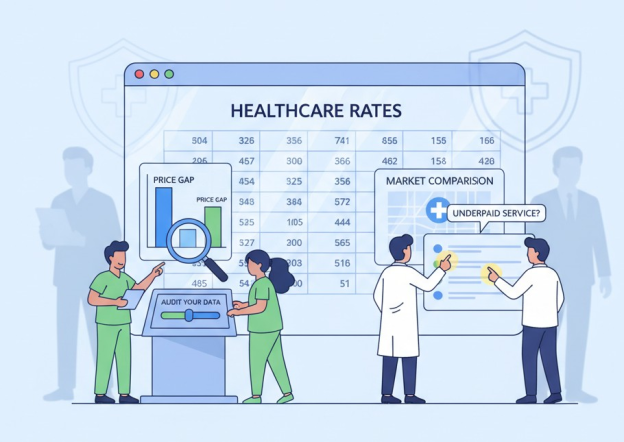
The New Burden of Proof: How Centers of Excellence Must Adapt in a Transparent World
This is Part 2 of our series. In Part 1, we explained how healthcare prices are now public, revealing massive cost differences for the same procedures.
So, we now know that a knee replacement at one top-notch hospital could cost $60,000 more than at another. It's a shocking number, but who does it actually affect? The answer is simple: it affects all of us.
Why Your Boss Is Suddenly Paying Attention
Most large companies are "self-funded," meaning they pay for their employees' medical costs directly from their own funds. As a result, these employers are highly sensitive to price variations in healthcare.

When an employer can see a $60,000 price difference for the same high-quality procedure, they have a powerful financial incentive to guide employees toward the provider that offers better value. They may begin to structure health benefits to encourage the use of more cost-effective hospitals, which helps control rising healthcare costs for the company and its employees.
This information is also important for individuals. Many people are enrolled in high-deductible health plans, which require them to pay a certain amount for their care out-of-pocket before insurance coverage begins.
When a patient is responsible for several thousand dollars of their medical bills, the ability to compare prices becomes a critical financial tool. Price transparency empowers patients to choose providers that offer high-quality care at a lower personal cost.
Why This Matters for Your Own Wallet

This shift in healthcare economics creates a new dynamic where patients can make more informed decisions about their care. The ability to compare prices empowers individuals to choose providers that offer high-quality care at a lower personal cost, potentially saving thousands of dollars on medical procedures.
The traditional model where patients relied solely on physician recommendations or hospital reputation is giving way to a more consumer-driven approach where price transparency plays a crucial role in healthcare decision-making.
A New Reality for the All-Star Hospitals
This transparent environment presents a new challenge for "Centers of Excellence." They can no longer rely solely on their reputation to justify premium pricing. They now face a new burden of proof.
To succeed in this new landscape, they must:
- Demonstrate Superior Outcomes: It is no longer sufficient to claim to be the best. Institutions must present data that proves their value, such as lower complication rates, faster recovery times, or better long-term results.
- Articulate Unique Value: Leading hospitals must clearly communicate what sets them apart. This could include access to unique technologies, specialized multidisciplinary teams, or participation in cutting-edge research that is not available elsewhere.
The institutions that embrace this new reality by backing up their prestige with hard data will not only survive, they will thrive. And in the end, that push for provable value is a win for everyone. Transparency isn't a threat to excellence, it's a challenge to prove it.